A comprehensive examination of the Tyr-hGH177-191 cyclic hexadecapeptide, chemical synthesis specifications, conformation stabilization, and its fundamental biological divergence from somatotropin.
AOD-9064 is a synthetic peptide fragment representing the C-terminus of human growth hormone (hGH), modified via an N-terminal tyrosine residue to stabilize the molecule and optimize receptor affinity. Its definitive primary sequence is H-Tyr-Leu-Arg-Ile-Val-Gln-Cys-Arg-Ser-Val-Glu-Gly-Ser-Cys-Gly-Phe-OH (often denoted as Tyr-hGH[177-191]).
The structural hallmark of AOD-9064 lies in its intramolecular disulfide crosslink between cysteine residues at position 7 and position 14 (homologous to Cys182 and Cys189 of native somatropin). In industrial synthesis, selective macrocyclization is required to prevent multimeric aggregation and parallel linear peptide side-products. The cyclized conformation is the decisive structural factor that triggers lipolytic signaling cascades while eliminating somatogenic systemic liabilities.
Standard full-length recombinant human growth hormone (191 amino acids, ~22 kDa) stimulates hepatic IGF-1 synthesis, produces antinatriuretic fluid retention, and impairs glycemic homeostasis by decreasing insulin sensitivity. AOD-9064 was explicitly engineered to decouple the lipolytic domain from the growth-promoting axis.
Extensive biochemical investigations demonstrate that AOD-9064 selectively upregulates β3-adrenergic receptors (ADRB3) in adipocyte membranes, triggering adenylate cyclase activation and subsequent intracellular cAMP accumulation. Crucially, the cyclic hexadecapeptide displays no binding affinity for the canonical human growth hormone receptor (GHR), preventing mitogenic signaling, chondrocyte hyperproliferation, and systemic insulin resistance.
| Physicochemical Parameter | Specification Criterion | Analytical Methodology | Factory Baseline (Hebei Miaoou Tech) |
|---|---|---|---|
| IUPAC / Chemical Nomenclature | Tyr-hGH (177-191) Cyclic Disulfide Acetate | Structural Modeling & NMR | Conforms to Pure Standard |
| CAS Registry Number | 221231-10-3 / Free Base: 300766-85-2 | Chemical Abstracts Service | Verified CAS Registry Record |
| Empirical Molecular Formula | C78H123N23O23S2 | Elemental Microanalysis | Stoichiometrically Validated |
| Monoisotopic / Average MW | 1815.1 g/mol / 1817.12 Da | High-Res ESI-TOF Mass Spectrometry | 1815.08 ± 0.5 Da (Monoisotopic Peak) |
| Disulfide Bond Topology | Intramolecular loop Cys7–Cys14 | UPLC-MS Peptide Mapping (Digest) | >99.2% Cyclic Bridge Formation |
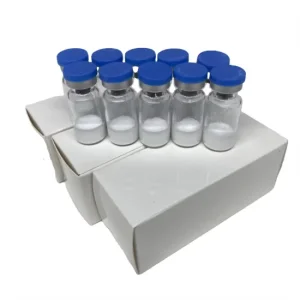
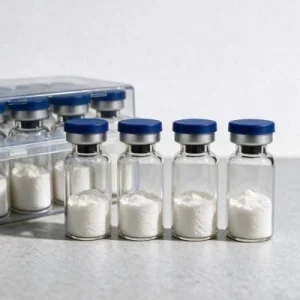
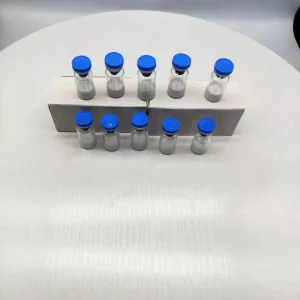
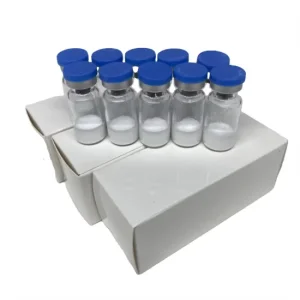
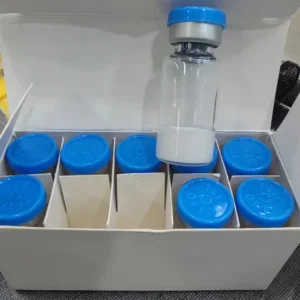
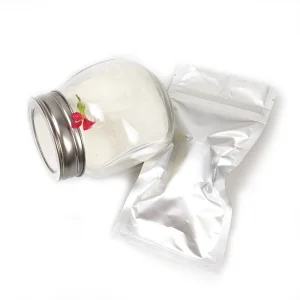
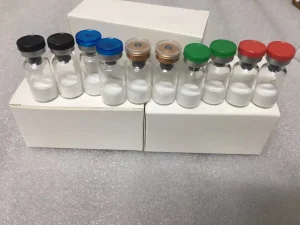
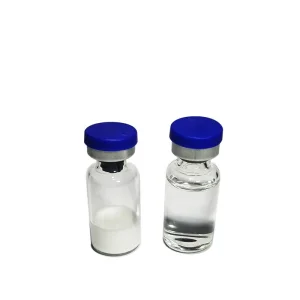
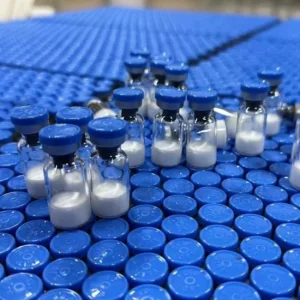
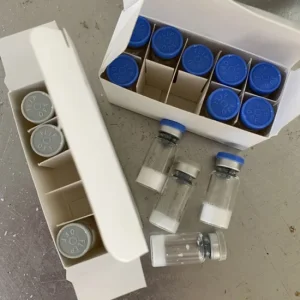
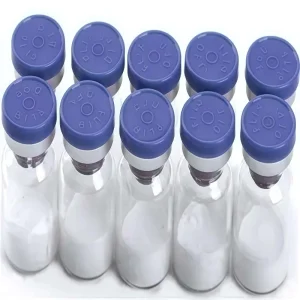
| Physical Appearance | Lyophilized white to off-white cake | Visual Inspection (Ph. Eur. 2.2.1) | Homogeneous Lyophilized Cake |
A recurring point of failure in global B2B procurement is confusing Gross Powder Mass with Net Active Peptide Content. Lyophilized peptides inherently retain counter-ions (such as acetate or residual trifluoroacetate) and hydration water. Our factory delivers absolute transparency: every Certificate of Analysis (CoA) explicitly distinguishes the chromatographic purity (≥99.0% by RP-HPLC) from the Net Peptide Content (≥82.5% determined via Kjeldahl or elemental nitrogen analysis), guaranteeing precise dosing accuracy for clinical trials and analytical formulations.
Strategic risk assessments for contract research organizations (CROs), biotech firms, and licensed compounding facilities when procuring bulk peptide active pharmaceutical ingredients (APIs).
During the 16-step solid-phase chain assembly of AOD-9064, steric hindrance at the sterically hindered Val-Val or Ile-Val junctions can lead to deletion peptides (e.g., [des-Val5]-AOD-9064 or [des-Ser13]-AOD-9064). These closely migrating impurities cannot be resolved by standard analytical chromatography without optimized gradient profiles.
Our Quality Control laboratory uses high-efficiency C18 core-shell stationary phases and multi-wavelength photodiode array (PDA) detection to identify and quantify single-deletion impurities to ≤0.2%, ensuring total unknown impurities remain strictly below ≤0.5% in every release lot.
Industrial peptide cleavage from resin routinely utilizes high-concentration trifluoroacetic acid (TFA). Residual TFA, if left unmanaged, forms tight salts with basic arginine residues (Arg3, Arg8), presenting cellular toxicity in biological cell-viability assays and causing localized tissue reactions.
Hebei Miaoou Technology executes automated semi-preparative ion-exchange chromatography, converting trifluoroacetate salts into pharmaceutical-grade acetate or hydrochloride salts. We ensure residual TFA levels are verified below 0.1% (w/w) via validated 19F-NMR and headspace gas chromatography.
While lyophilized peptide powder remains stable at ambient temperatures for short transit windows, aqueous reconstitution or exposure to high temperatures accelerates deamidation of the Gln6 residue into Glu6, followed by disulfide bridge scrambling.
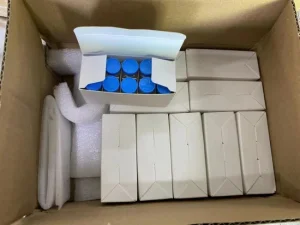
All bulk orders of AOD-9064 destined for North America, the European Union, Australia, and ASEAN markets are packed within validated thermal shippers equipped with real-time temperature loggers (USB/cloud-connected) that verify storage within 2°C to 8°C or dry ice (-20°C) throughout international customs transit.
A rigorous industrial perspective on resin functionalization, orthogonal protection groups, air/iodine cyclization kinetics, and dynamic axial compression purification.
Synthesis initiates on 2-Chlorotrityl chloride (CTC) resin or high-swelling Wang resin pre-loaded with Fmoc-Phe-OH. Sequential elongation is executed in automated microwave-assisted synthesizers using Fmoc-protected amino acids with orthogonal side-chain protection: Arg(Pbf), Cys(Trt), Ser(tBu), Glu(OtBu), Gln(Trt), and Tyr(tBu).
Coupling is driven by DIC/OxymaPure or HBTU/DIPEA activation in degassed N,N-dimethylformamide (DMF). Continuous in-line UV-monitoring traces Fmoc deprotection cycles to prevent truncated chain growth.
Mild cleavage cocktails (TFA/TIS/EDT/H2O 92.5:2.5:2.5:2.5) release the linear precursor while preserving thiol groups. Cyclization of the Cys7–Cys14 disulfide bridge is executed under ultra-dilute conditions (0.5 to 1.0 mg/mL) in an aqueous-organic buffer system.
By modulating pH to 8.2–8.5 using ammonium bicarbonate or utilizing controlled I2/methanol oxidation, the reaction achieves >96% cyclization yield within 4 hours, suppressing inter-chain intermolecular crosslinking.
The crude cyclized solution is directed through two-stage dynamic axial compression (DAC) columns packed with 10 μm spherical C18 silica (100Å pore size). Mobile phase A (0.1% HOAc in H2O) and Mobile phase B (HPLC grade acetonitrile) create an optimized shallow gradient.
Target fractions are pooled, filtered through 0.22 μm PES sterile membranes, and loaded into pilot-scale freeze-dryers. A multi-step 48-hour shelf-cooling and primary/secondary sublimation cycle yields uniform, crystalline-free lyophilized cakes with moisture content <3.0%.
Addressing the critical transition from laboratory-scale proof-of-concept to metric-ton commercial supply chains with strict cGMP compliance frameworks.
Hebei Miaoou Technology operates fully automated, isolator-enclosed aseptic liquid dispensing and stoppering lines capable of handling custom vial dimensions ranging from 2 mL to 20 mL tubular glass vials (USP Type I borosilicate).
For biopharmaceutical enterprises preparing Investigational New Drug (IND) applications or research approvals, we supply comprehensive Chemistry, Manufacturing, and Controls (CMC) technical documentation.
How emergent chemical breakthroughs in green manufacturing, enzymatic ligation, and nano-encapsulation are reshaping the commercial landscape of AOD-9064.
Phasing out hazardous petroleum-derived dipolar aprotic solvents (DMF, NMP) in favor of environmentally benign alternatives such as Cyclopentyl methyl ether (CPME), 2-Methyltetrahydrofuran (2-MeTHF), and water-based micellar peptide synthesis, reducing carbon footprint by 65%.
Transitioning from batch stirred reactors to high-throughput continuous flow microfluidic synthesis. Continuous flow enhances mass and heat transfer, allowing amino acid coupling cycles under 3 minutes with zero localized hotspots, driving crude purity past 92%.
Deploying engineered protein disulfide isomerases (PDIs) and subtiligase-derived enzymes for high-fidelity regioselective cyclization. Enzymatic ligation operates under neutral pH in aqueous media, entirely eliminating toxic heavy metal or halogen oxidation reagents.
Collaborative research initiatives exploring Lipid Nanoparticle (LNP) encapsulation, PLGA-PEG microspheres for extended 30-day therapeutic release, and microneedle patch transdermal delivery platforms, overcoming peptide proteolytic degradation in biological matrices.
Navigating cross-border customs regulations, documentation requirements, and quality system assurances across global jurisdictions.
Peptide active materials are subject to stringent customs scrutiny across the US CBP, EU member states, and Australian Border Force. Miaoou Technology coordinates complete harmonized tariff classification (HS Code 2937.19), proforma commercial invoices, non-dangerous goods (Non-DG) declarations, and toxicological safety profiles.
Our dedicated international logistics desks provide door-to-door, DDP customs-cleared logistics routes to streamline delivery for analytical laboratories and university research facilities.
B2B procurement requires direct communication with professionals who understand analytical chemistry. We pair every corporate partner with a dedicated bilingual project manager and synthetic chemist available 24/7 across global time zones (EST, GMT, CET, AEST).
Whether addressing custom synthesis parameters, salt exchange preferences, or specialized analytical batch re-tests, clients receive formal technical feedback within 24 hours.
To eliminate bias and build complete trust, Hebei Miaoou Technology works with leading accredited ISO 17025 third-party testing laboratories (such as Janoshik Analytical, MZ Biolabs, and SGS). Customers can verify lot-specific certificates independently prior to clearing inventory release.
Every commercial container features a cryptographically secure QR code linking directly to public and third-party verified analytical spectra.
Detailed technical answers addressing chromatography evaluation, peptide reconstitution, salt forms, storage stability, and global commercial order fulfillment.
Confirmation of the intramolecular Cys7–Cys14 disulfide crosslink requires advanced analytical methodology beyond routine molecular weight determination. Because linear reduced AOD-9064 and cyclic oxidized AOD-9064 differ in molecular mass by only 2 Daltons (due to the loss of 2 hydrogen atoms), standard low-resolution mass spectrometry can easily misidentify the material.
Our quality control workflow utilizes high-resolution UPLC-ESI-QTOF-MS combined with Ellman's reagent assay (DTNB test) to quantify free sulfhydryl (-SH) groups. A zero or negligible detection of free thiols (<0.5%), combined with a distinct retention time shift on reversed-phase HPLC (the cyclic form elutes earlier due to reduced hydrodynamic radius and decreased hydrophobic exposure), verifies complete disulfide bridge formation.
During solid-phase peptide synthesis (SPPS), cleavage cocktails utilize trifluoroacetic acid (TFA), leaving basic amino acid side chains (such as Arg3 and Arg8) bound to trifluoroacetate counter-ions. While TFA salts are suitable for non-biological analytical reference standards, residual TFA is notoriously cytotoxic in cell culture and living tissues, causing cellular apoptosis and unrepresentative biological readouts.
Our factory performs automated preparative ion-exchange chromatography to convert the peptide into an Acetate salt form (<1.0% residual TFA). For specialized biomedical formulations, we can also supply the material as a Hydrochloride (HCl) salt or desalted free base upon request.
Lyophilized Powder: Store at -20°C in a desiccated environment protected from light. Under these conditions, the dry peptide remains stable with <0.5% purity degradation over a 24-month validation period. Avoid repeated freeze-thaw cycles of the dry vial.
Reconstitution: Reconstitute using sterile bacteriostatic water (0.9% benzyl alcohol) or sterile physiological saline (0.9% NaCl). To reconstitute, inject the diluent against the inner glass wall of the vial, not directly onto the lyophilized cake. Allow the vial to dissolve via gentle swirling; never vortex violently, as shearing forces can denature peptide secondary structures and cause precipitation. Once reconstituted, store at 2°C to 8°C and use within 28 days.
For catalog stock products (such as 2 mg, 5 mg, or 10 mg lyophilized vials), our standard minimum order quantity begins at 10 vials. For custom bulk raw powder synthesis (API scale), our synthesis suites support gram-scale pilot runs starting from 10 grams up to multi-kilogram industrial production runs.
Custom packaging, sterile vialing, specific salt exchange requirements, and customized lyophilization cycle design can be tailored to meet your institutional procurement specifications.
Every commercial order dispatched from our facility includes an exhaustive quality release dossier:
Hebei Miaoou Technology has more than 16 years of international logistics experience. We prepare full export documentation, non-hazardous chemical declarations, certified commercial invoices, and accurate HS code classifications (HS: 2937.19). For high-volume destinations in the US, Europe, Canada, and Australia, we offer insured, door-to-door customs-cleared logistics services that guarantee smooth delivery without customs delays.