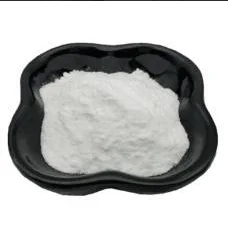
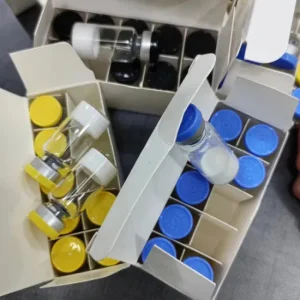
Factory-direct synthesized bio-active compounds, verified reference powders, and analytical reagents available for immediate global B2B supply.
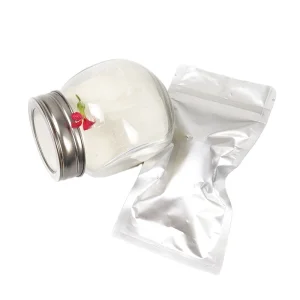
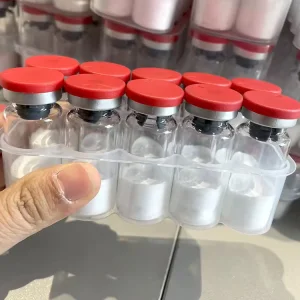
Rigorous chemical taxonomy, conformational stability metrics, and physical-chemical identification parameters for technical procurement directors.
CAS 189691-06-3 chemically identifies Bremelanotide free base, structurally recognized as a synthetic cyclic heptapeptide analog of alpha-melanocyte-stimulating hormone (α-MSH). The primary sequence is formulated as Ac-Nle-cyclo[Asp-His-D-Phe-Arg-Trp-Lys]-OH.
Its molecular formula is recorded as C50H68N14O10, bearing a theoretical monoisotopic mass of 1024.52 g/mol. The molecule utilizes an internal lactam bridge linking the β-carboxyl group of aspartic acid to the ε-amino group of lysine, providing immense proteolytic resilience.
In commercial trading and industrial synthesis, CAS 189691-06-3 is synthesized either as an unbuffered base or converted via counter-ion exchange into Bremelanotide Acetate (CAS 1607799-13-2 / CAS 189691-06-3 base equivalent). The presence of the basic arginine side-chain requires rigorous control of counter-ion ratios.
Leading Chinese cGMP facilities ensure net peptide content (NPC) typically calibrates between 82.0% and 88.5%, with residual acetic acid controlled between 4.0% and 11.0% (w/w), precluding unwanted degradation kinetics during reconstitution.
Unlike linear precursors such as Melanotan-II, Bremelanotide possesses a terminal hydroxyl modification on the lysine moiety instead of a carboxamide terminus, altering its receptor affinity profile.
Its cyclized structure enforces a rigid spatial display of the Pharmacophore domain (-His-D-Phe-Arg-Trp-), exhibiting nanomolar affinity across melanocortin receptors (MC3R and MC4R), driving global academic interest in central nervous system signal transduction.
| Analytical Parameter | Specification Target | Testing Methodology | Quality Impact Matrix |
|---|---|---|---|
| Chemical / IUPAC Designation | CAS 189691-06-3; Bremelanotide / PT-141 | Chemical Inventory Indexing | Absolute chemical identity benchmark |
| HPLC Chromatographic Purity | ≥99.00% (Individual Impurity ≤0.50%) | RP-HPLC (C18, 214nm / 220nm gradient) | Prevents truncated and diastereomeric cross-reactivity |
| Molecular Mass Verification | 1024.52 ± 0.5 Da (Exact Mass [M+H]+ = 1025.5) | High-Resolution ESI-MS / MALDI-TOF | Confirms absence of incomplete side-chain deprotection |
| Residual Trifluoroacetic Acid (TFA) | ≤ 0.25% (or below LOQ via Acetate Conversion) | Ion Chromatography / 19F-NMR | Guarantees minimal cellular toxicity in bio-assays |
| Bacterial Endotoxin Content | ≤ 5.0 EU/mg (Bio-research grade ≤ 10 EU/mg) | Kinetic Turbidimetric / Chromogenic LAL | Critical compliance for in vivo experimental setups |
Mapping the macro-economic trajectory, research pipeline consumption, and supply chain geography across North American, European, and Asia-Pacific markets.
Global demand for CAS 189691-06-3 stems fundamentally from its verified efficacy as a centrally acting receptor agonist. Unlike peripheral PDE5 inhibitors that target downstream vascular smooth muscles, Bremelanotide targets hypothalamic pathways.
This distinct mechanism has prompted an influx of venture-backed clinical explorations into female hypoactive sexual desire disorder (HSDD), erectile dysfunction unresponsive to cyclic GMP pathway modifiers, and novel neuro-protective cognitive trials.
As contract research organizations (CROs) scale peptide profiling platforms, reference material conforming to CAS 189691-06-3 is consistently consumed as positive control calibrators in competitive radioligand binding assays, Western blot controls, and cellular cAMP accumulation tests.
Procurement teams require traceable analytical batches accompanied by verified high-resolution spectra to benchmark custom synthesized cyclic libraries.
Significant international investment is directed toward non-invasive administration vectors. Academic and clinical groups utilize ultra-pure CAS 189691-06-3 raw materials to formulate intranasal aerosols, biodegradable PLGA microspheres, and transdermal microneedle arrays.
These advanced delivery models demand stringent physical metrics, including exact crystalline particle size distribution (PSD) and ultra-low bioburden limits.
Why leading global biotech corporations source CAS 189691-06-3 from optimized Chinese chemical clusters: An engineering perspective.
Chinese fine-chemical manufacturing clusters in Hebei, Jiangsu, and Zhejiang utilize state-of-the-art continuous-flow microwave-assisted and automated mechanical-stirred SPPS reactors up to 1000-liter capacity.
By employing high-loading 2-Chlorotrityl Chloride resins and optimized DIC/OxymaPure coupling methodologies, Chinese synthesizers suppress D-Phe racemization to <0.15%, dramatically increasing overall crude yields from 62% to over 84% prior to purification.
China commands over 70% of global industrial output for protected Fmoc-amino acids (such as Fmoc-Nle-OH, Fmoc-Lys(Alloc)-OH, and Fmoc-D-Phe-OH). Domestic sourcing of these critical chemical precursors eliminates transatlantic freight markups and customs delays.
This vertical industrial synthesis hierarchy creates a resilient barrier against global supply shocks, assuring overseas buyers uninterrupted supply continuity even during peak market cycles.
Purification of cyclic peptides represents the most cost-intensive phase of manufacturing. Chinese facilities deploy multi-column industrial preparative HPLC systems featuring 200mm to 300mm DAC (Dynamic Axial Compression) columns loaded with spherical 10μm C18 silica.
This allows rapid isolation of pure target fractions at multikilogram single-batch throughput, reducing solvent consumption via recycling systems and lowering the per-gram unit pricing for global enterprise customers.
Audit guidance for procurement professionals: Ensuring regulatory integrity and structural validity before commercial contract finalization.
Never accept suppliers supplying purely static purity claims. High-resolution RP-HPLC runs must feature both UV-Vis absorption profiling at dual wavelengths (typically 214nm for peptide backbone peptide bonds and 280nm for aromatic tryptophan residues).
Ensure that chromatographic conditions disclose flow rate (e.g., 1.0 mL/min), stationary phase details, mobile phase compositions (A: 0.1% TFA in H2O, B: 0.1% TFA in ACN), and elution gradients. Total area percentage must exceed 99.0%.
Authentic CAS 189691-06-3 must demonstrate molecular mass integrity via Electrospray Ionization (ESI-MS) or Matrix-Assisted Laser Desorption/Ionization (MALDI-TOF). Spectra must unequivocally demonstrate the protonated molecular ion [M+H]+ at m/z 1025.5 ± 0.5 Da, along with secondary multi-charge states ([M+2H]2+ at m/z 513.3).
The absence of deletion fragments (ΔHis or ΔTrp) confirms complete chemical coupling and flawless cleavage protocol.
Raw synthesis yields material loaded with trifluoroacetate salts, which can disrupt cellular assays and preclinical protocols. Premium export suppliers provide documented counter-ion exchange converting material into an acetate form.
Verification must confirm residual solvents meet USP <467> and ICH Q3C limits (Acetonitrile <410 ppm, Dichloromethane <600 ppm, Diethyl ether <5000 ppm) alongside moisture content determined via Karl Fischer titration (<5.0%).
Anticipating regulatory tightening and technological transitions in global peptide active pharmaceutical ingredient (API) supply chains.
Global environmental mandates (such as EU REACH regulations) are enforcing strict limits on traditional peptide solvents like N,N-Dimethylformamide (DMF) and N-Methyl-2-pyrrolidone (NMP). Chinese chemical manufacturers are leading pilot transformations using green alternatives like 2-Methyltetrahydrofuran (2-MeTHF) and dihydrolevoglucosenone (Cyrene).
This forward-looking transition ensures buyers maintain uninterrupted customs clearance and adhere to environmental, social, and governance (ESG) corporate mandates.
Conventional head-to-side-chain or side-chain-to-side-chain cyclization relies heavily on toxic chemical cross-linking reagents (e.g., PyBOP, HATU). Research breakthroughs in Chinese national bio-chemical engineering centers are deploying recombinant peptide cyclases (such as modified butelase enzymes).
Biocatalytic cyclization achieves quantitative yields within minutes at ambient water-buffered temperatures, slashing side-reaction impurities and setting new benchmarks for peptide purity.
Moving away from batch vessels, cutting-edge Chinese facilities are scaling microfluidic continuous-flow synthesizers. Continuous flow allows real-time spectroscopic feedback (Process Analytical Technology - PAT), keeping coupling reactions under sub-second thermal control.
This modern infrastructure virtually eliminates regional peptide variations, providing institutional buyers with guaranteed batch-to-batch consistency across multihundred-kilogram annual contracts.
Authoritative, evidence-backed answers address regulatory compliance, chemical stability, handling guidelines, and supply logistics.
While both compounds are synthetic cyclic peptide analogs designed to interact with melanocortin receptors, their structural architectures and biological targets diverge significantly. Melanotan-II possesses a terminal amide (-NH2) group on its lysine tail and exhibits non-selective agonism across MC1R, MC3R, MC4R, and MC5R, which prominently stimulates melanogenesis (skin pigmentation). In contrast, Bremelanotide (CAS 189691-06-3) features a free carboxyl (-OH) terminus on its lysine residue and is an active metabolite of Melanotan-II. This modification significantly reduces its affinity for peripheral MC1R melanogenic receptors while concentrating functional agonism on central MC3R and MC4R pathways within the hypothalamus, making CAS 189691-06-3 optimal for neuro-endocrine and sexual dysfunction research without primary skin tanning side effects.
Lyophilized Bremelanotide exhibits excellent physical and chemical stability when stored under appropriate environmental parameters. For long-term preservation (>24 months), the desiccated powder must be maintained at −20°C or −80°C in a moisture-free environment, shielded entirely from direct light. Before opening the sealed amber or clear glass vial, allow the container to equilibrate naturally to room temperature to prevent atmospheric condensation on the lyophilized cake. Once reconstituted with sterile bacteriostatic water or physiological saline, the solution must be stored at 2°C to 8°C and utilized within 21 to 28 days. Repeated freeze-thaw cycles must be strictly avoided, as mechanical shear stress from crystal formation promotes cleavage of the cyclic lactam bridge.
Procurement teams and lab scientists must never confuse total gross powder mass with net peptide content. A 10mg vial of lyophilized Bremelanotide consists of peptide along with counter-ions (such as acetate or trace trifluoroacetate) and residual bound hydration water molecules. In premium products, the net peptide content (NPC) typically averages 85%. Consequently, a 10mg gross powder sample contains approximately 8.5mg of active Bremelanotide base. When configuring precise molar concentrations for in vitro binding curves or quantitative HPLC standard injections, calculations must always calibrate against the net peptide content documented on the batch-specific Certificate of Analysis (COA) to prevent serious under-dosing or experimental variance.
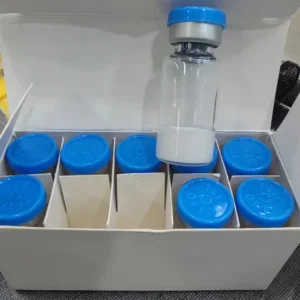
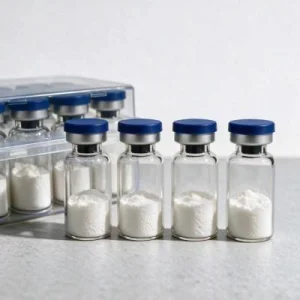
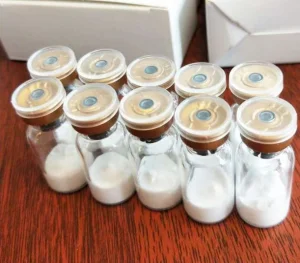
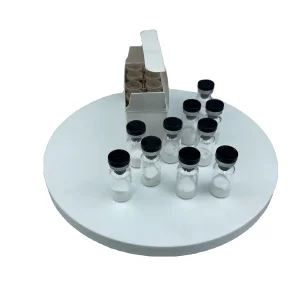
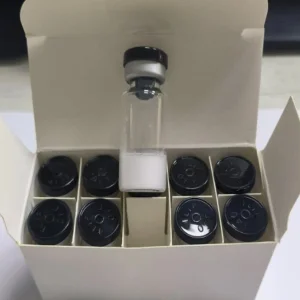
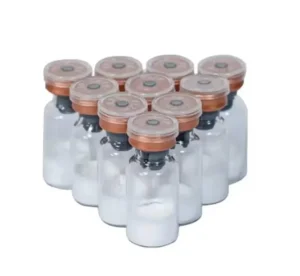
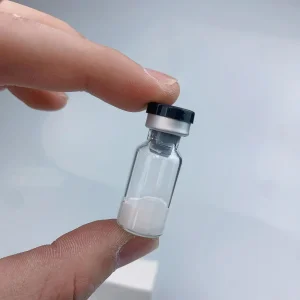
Chinese direct manufacturing facilities support both analytical micro-vial configurations and multi-kilogram commercial bulk syntheses. Standard configurations include sterile 2mg, 5mg, and 10mg borosilicate Type-I glass vials sealed under high-vacuum nitrogen purge with chlorobutyl stoppers and flip-off aluminum crimps. For pharmaceutical formulators, CROs, and industrial buyers, bulk powder is vacuum-packaged in double-layered anti-static pharmaceutical-grade polyethylene bags placed inside hermetically sealed aluminum foil pouches with silica desiccant canisters, packaged inside tamper-evident fiber drums (1kg, 5kg, and 25kg capacity).
Shipments destined for international destinations are supported by a full regulatory and analytical documentation dossier. This includes a certified Certificate of Analysis (COA) detailing batch release parameters, raw analytical RP-HPLC chromatograms, High-Resolution Mass Spectrometry (HRMS) reports, an SDS (Safety Data Sheet) compliant with GHS Revision 8 / OSHA HazCom 2012 standards, a Certificate of Origin (COO), and formal customs commercial declarations classifying the product under HS Code 2933990099 or 2937190000. For qualified institutional partners, technical DMF (Drug Master File) open-part documentation can be supplied for commercial registration assistance.
Complete commercial product lines: Hormonal regulators, therapeutic peptides, reference materials, and high-yield raw powders.